Session Limits: When Time Quietly Slips Out Of Your Hands

This guide is suitable for beginner players.BeginnerPercentage of users that found this guide helpful.0%Estimated reading time based on the average reading speed.6 Min
If you ask most people how long they plan to gamble, they have a simple answer:
What surprises people isn’t the intention, but how often reality stretches past it without anyone noticing.
Gambling doesn’t have natural stopping points anymore. There’s no closing time, no last round, no external signal that says this is a good moment to leave. You play, you hope the next round will hit, you feel luck is coming, and the reasons to stay keep multiplying.
Games flow seamlessly into each other, balances update instantly, and as long as you’re logged in, there’s always another decision waiting.
And to be clear: this isn’t about judging anyone, that’s not the main idea. It’s about how attention works when something is engaging, repetitive, and emotionally stimulating. When your focus narrows, your sense of time follows it.
Time is money, and that’s not only a social media bio.
Money gets all the attention, but time is the quieter cost. Unfortunately, I hear all the time how long sessions end up lasting into the evening, cutting into sleep, and slowly taking up more room than they should.
What makes this tricky is that it doesn’t always feel harmful in the moment, especially if spending feels controlled or you add some stake limits in the discussion.
The reality is that gambling is fun, sure, but it becomes a part of everyday life for a huge number of people. With hundreds of billions in annual revenue and over a billion users worldwide, most gambling sessions are familiar, habitual, and easy to underestimate, and of course, the time becomes slippery.
Session limits acknowledge this reality, and they recognise that when an activity is always available and frictionless, it needs structure if it’s going to stay intentional.
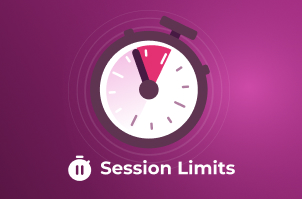
Session limits are enforced at the account level and measured in real time, not estimated. Once you hit the duration you selected, access is paused or ended automatically.
Depending on the country, some platforms log you out completely, and others block wagering while keeping your account visible. Either way, the session doesn't just quietly continue in the background.
In many regulated markets (e.g UKGC ), platforms must provide time controls such as reality checks/time reminders, and often offer session limits as an extra tool. Exact requirements vary by jurisdiction. In looser environments, well, session limits may exist, but they do reset too easily, trigger warnings instead of hard stops, or allow immediate re-entry without any pause.
The point isn’t just to warn you - it’s to create a real stop at the time you chose.
Extended gambling sessions don't usually feel intense. They feel flat, and that's part of the problem. When you're feeling tired, your brain tries to take the path of least resistance, and that usually means sticking with what you're doing. Switching activities takes effort. Stopping requires a decision. Continuing doesn't.
Deposit limits keep money out of the game before it starts, and stake limits control how much intensity there is for each action.
Session limits can catch the fatigue. They step in when your judgment starts to slip, but before your behavior looks extreme. Many risky decisions happen later in a session, when fatigue builds and stopping feels harder.
Regulators are starting to see that how long a session lasts and how fast the game goes are connected. If bets can be placed quickly and sessions can run forever, players make up for lower stakes by betting more. That's why some places put limits on how long people can play, how fast they have to play, or they make people take breaks.
When games slow down and players are nudged to take breaks, it can help people step back and make clearer decisions. Session limits restrict how much someone can be exposed to, not how they act.
Most of the time, playing too long just leaves you a bit foggy, a bit flat, and a bit more irritable than you expected to be. And that's important because there's nothing worse than feeling half there and half asleep.
Session limits aren't there to stop you from having fun gambling, but they help you deal with the mental drain that builds when sessions stretch past your attention. Ending earlier helps you sleep better, stay in a good mood, and gives your brain the space it needs to rest. That protection doesn't show up on a balance sheet, but you feel it the next day.
If gambling ever leaves you more tired than entertained, or mentally heavier than when you started, it doesn't mean something is wrong with you. It just means your brain has had enough input for one sitting. Session limits are there for when you've had your fill.
They don’t fix everything, but they do one crucial thing well: they help you walk away before gambling starts taking more from your head than you ever meant to give.