
Loss Limits: The Line You Decide Not To Cross

This guide is suitable for beginner players.BeginnerPercentage of users that found this guide helpful.0%Estimated reading time based on the average reading speed.6 Min
Nobody wakes up excited to set a loss limit. It’s not a feature anyone brags about using, and it doesn’t feel clever or strategic. Some will say it feels cautious, slightly pessimistic, almost like admitting you might have a bad day; and even if that’s true, why is it a bad thing?
At the end of the day, make sure the gambling was still a fun activity, not your worst nightmare. Most harm doesn’t come from one wild decision. It comes from staying a bit longer than planned, several times in a row, thinking, “I’ll play a bit more and see if it balances out”.
Loss limits aren’t there for the first bet, or even the second – they exist for that stretch of play where things aren’t going great, but also aren’t bad enough to make you stop on your own.
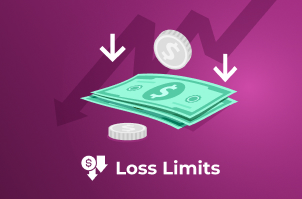
A loss limit is you deciding, in advance, how much you’re genuinely okay with losing in a day, week, or month, and letting the system step in when emotions and fake confidence start making the moves.
Note: Loss-limit tools and calculations vary by country and platform - always check the rules shown inside your account.
Unlike deposit limits, loss limits track your net result over a period (money in minus money out), not just activity.
A loss limit answers one particular question in advance: How much money am I genuinely okay with losing over a certain period without feeling annoyed, stressed, or regret tomorrow?
What matters is your net result for the period: money in minus money out - how much is actually gone. The platform tracks that net position, not the moment-to-moment swings.
If you want to avoid the word “operators” entirely (since you prefer not to mention casinos/brands), this replacement also solves that automatically.
Wins are counted, of course. Withdrawals matter. What’s left is the real damage, the number you’d mention if someone asked, “How did it go?” When that number is reached, play stops for that period.
Let’s Take It Slowly
You start with €0 in your gambling account.
The full picture, outside the platform, is:
That means you’re €80 down overall. That €80 is your real loss. It’s the amount that’s gone from your bank, not counting the ups and downs in between. This is the number a loss limit tracks.
Deposit limits focus on money coming in, session limits focus on time, but loss limits focus on the result.
Worth remembering:
If you deposit €100, win €80, lose €120, withdraw €20, and then keep playing, a deposit limit doesn’t see a problem. A loss limit does. It looks at where you are now, not how busy your session looked along the way.
Loss limits often feel “stricter” than expected. They don’t reset just because you had a good run earlier, and certainly, they don’t care how close you were to being even. They care about the final position, and your head the next day.
Loss limits tend to activate at the worst possible moment: when you still feel like there’s room to turn it around.
Most sessions don’t end neatly when money runs out - they end when attention collapses, or frustration becomes stronger than hope.
A loss limit steps in before either of those happens, which is why it can feel abrupt.
Of course, it doesn’t wait for you to agree. It’s the decision you made earlier, with a clear head, stepping in to protect your pocket.
Most platforms don’t allow instant increases to loss limits, and that delay isn’t arbitrary.
In Great Britain, UKGC RTS 12D requires customer-led limit increases only after a cooling-off period (at least 24 hours) and confirmation, while reductions should be immediate.
Many regulated sites require a cooling-off period and confirmation for increases.
People rarely ask for higher limits because their financial situation has changed in the last ten minutes ( Nobody will believe that.) They ask because the session didn’t go as they expected, and continuing feels easier than stopping.
The waiting period forces a separation between impulse and permission. It gives the decision time to survive outside the emotional context that created it. If the higher limit still makes sense after a break, a day, a coffee, a good sleep, then okay, fine. If not, the system has just prevented a loss that would have felt justified in the moment and pointless later.
People who use limits successfully over time tend to treat them as non-negotiable. They set them once, based on money they can afford to lose without resentment, and they don’t touch them mid-session.
When the limit hits, the decision is already made. There’s no argument, no internal bargaining, no “just five more minutes”, and no fight with the live chat. The session ends because it was always meant to end there.
Need support?
If gambling feels hard to stop or is starting to affect your life, consider contacting a local gambling support service or helpline in your country.
Nobody enjoys losing money. A loss limit isn’t about pretending losses won’t happen - it’s about deciding your line before the mood, frustration, or “just one more” thinking shows up.
It won’t change the randomness of a session. What it does change is what happens next: it stops a bad run from turning into extra time and extra money spent trying to “fix” the night.
Set a number you can genuinely afford to lose, treat it like part of your gambling budget, and let the limit end the session when it’s hit. If you feel the urge to raise it in the moment, that’s usually your cue to step back - not negotiate.
It’s not exciting. It’s just clean. And it saves you from dragging a rough session further than it deserves.
BeGambleAware is an independent charity that empowers responsible gambling across the UK.
The charity provides gambling prevention and treatment services for gamblers and affected families through a safe, professional environment.
BeGambleAware Official Website